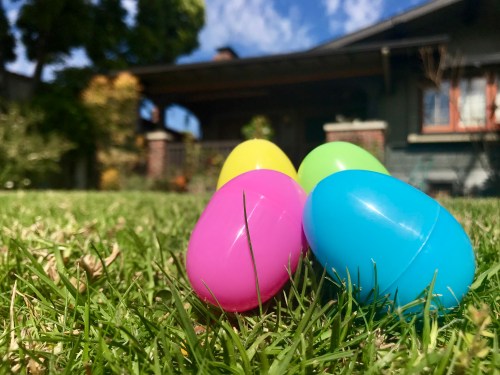
 Many of you may be familiar with Easter eggs. No, not the kind filled with candy that children go hunting for this time of year. The Easter eggs we’re referring to are hidden features, messages or images in a video game. With the holiday weekend upon us, we thought it would be fun to highlight some of Alhambra’s architectural Easter eggs – those architecturally significant structures and/or features that may be easy to miss if you’re not looking for them. Here are just a few – waiting to be found by you!
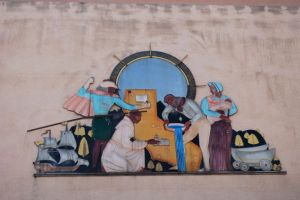 Millard Sheets Murals at Mark Keppel High School – In the late 1930s, as Alhambra’s Mark Keppel High School was being built, Millard Sheets – a Chouinard Art Institute graduate and leading figure behind the California Style watercolor movement – created three exterior enamel and stainless steel relief murals. The murals remain today. The three murals depict the history and culture of early California with one showcasing the state of California, the second featuring Los Angeles County and the third showing three groups of people who populated early California. (Mark Keppel High School, 501 East Hellman Avenue, Alhambra)
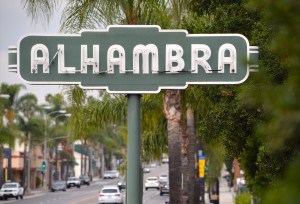 Neon “Alhambra” Welcome Signs – At the western, eastern and southern entrances to the city of Alhambra, you’ll find “Alhambra” neon signs, which welcome visitors to our city. Currently only the southern sign on Valley Blvd. is working. Neon signs and their rich history date back to the early 1900s. The French chemist, inventor and engineer Georges Claude introduced the first neon lamp to the public in 1910; he introduced neon signs to the US in 1923. In addition to its welcome signs, Alhambra has two historic businesses that use neon signs. The Hat on Valley Blvd. and Bun N Burger on Main St. both feature vintage neon signs. Alhambra’s Arts and Cultural Events Committee is considering the restoration of Alhambra’s neon welcome signs. APG applauds this idea. (Alhambra’s neon signs – Huntington Blvd. at the border of El Sereno, Main Street at the border of San Gabriel, Valley Blvd. at the border of Los Angeles)
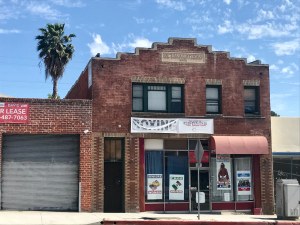 Joe Candalot & Sons Building – Just east of Alhambra’ neon sign on Valley Blvd. at the terminus of the 710 Freeway, you’ll find a simple non-descript two-story brick building with the words “Joe Candalot & Sons – 1926” imprinted near the roof. In 1899, Sylvestre Dupuy – the original owner of Alhambra’s Pyrenees Castle – married Anna Candalot, a young Frenchwoman and accomplished chef. They raised four children – a daughter and three sons – in Alhambra. After the Dupuy’s moved into the Pyrenees Castle in 1927, the couple began developing lots on present-day Valley Blvd. Mr. Dupuy set up his sons in the tire business, naming it Y Tire Sales, which is still located on Valley Blvd. and is still owned by the Dupuy family. Whether this building in southwestern Alhambra was at one time the offices of Y Tire Sales has yet to be proven. And who was Joseph Candalot? Anna Candalot Dupuy’s father? Her brother? We’re still researching this branch of the Dupuy family. But the fact that the Candalot name features prominently on the building’s edifice links it to Alhambra’s Pyrenees Castle somehow. (Joe Candalot & Sons Building, 3078 Valley Blvd., Alhambra)
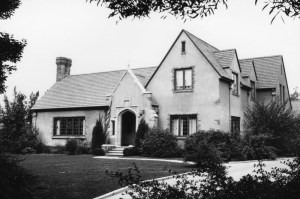 Alhambra’s Millionaire’s Row – In the early 20th century, many cities had neighborhoods that came to be known as “Millionaire’s Row.” These were streets lined with mansions owned by wealthy and influential city leaders. Alhambra was no different. During the 1920s and 30s, Alhambra’s elite lived on North Almansor Street in the Orange Blossom Manor tract, which featured homes with revivalist architectural styles ranging from English Tudor to American Colonial, from Dutch Colonial to Spanish Colonial. The homes were owned by such Alhambra luminaries as Victor Clyde Forsythe, renowned southwest Plein Air painter; Frank Olson, a lumberman who owned Olson Lumber and whose stunning English Tudor Revival home remains today; and Elmer Bailey, an experienced citrus orchardist who established the Golden Pheasant brand. Homes on Alhambra’s Millionaire’s Row have been featured on home tours and in movies. (Alhambra’s Millionaire’s Row, North Almansor Street north of Main Street)
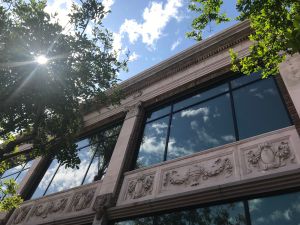 Former Home Furniture Company Building Façade – As you drive east on Main Street just past Garfield Avenue, look to your left and you’ll discover a building that looks decidedly different than its neighbors. Several years ago, the 1970’s façade of this building was removed and an early 20th century storefront was discovered underneath. This building was the original location of Alhambra’s Home Furniture Company, which was Alhambra’s preeminent furniture store in the early 20th century. Boasting more than 32,000 square feet of furniture display space, the Home Furniture Company saw several owners during its lifetime. Today the façade that remains features decorative pillars and ornamental urns adorned with garlands of fruit and ribbon. (Former Home Furniture Company Building, 43 East Main Street, Alhambra)
We hope you enjoyed reading about a few of Alhambra’s architectural Easter eggs and the stories behind these gems. There are many more to be found in Alhambra, which is why a citywide historic resources inventory is overdue and necessary. We simply don’t know where all of our city’s architectural Easter eggs are hidden. It’s time to find them all and discover Alhambra!
Note: If you do decide to visit these locations or look for additional architectural Easter eggs in Alhambra, we ask that you not disturb business owners, residents and students. Happy hunting!
Did we miss any of Alhambra’s architectural Easter eggs? If you’re aware of any, please tell us about it in the comments below. We’d love to hear from you!
Photo courtesy of Alhambra Preservation Group.
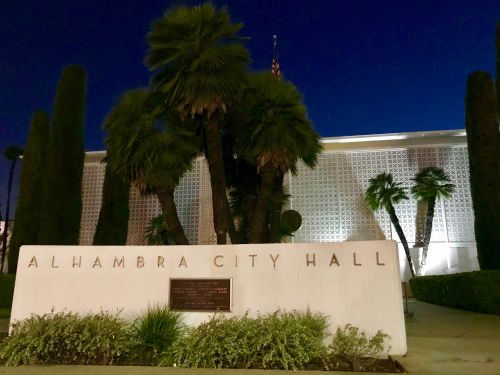 The City of Alhambra Planning Commission will consider the final draft of the City of Alhambra General Plan at public meetings on Monday, May 6 and Monday, May 20, 2019. Both meetings will take place at Alhambra City Hall, City Council Chambers, 111 South First Street, Alhambra, CA 91801 and will begin at 7:00 p.m.
 Spring has sprung and there’s a lot going on in our city and the San Gabriel Valley over the next few weeks. Here are just a few of the events and activities that you may want to check out:
 As 2019 begins,
 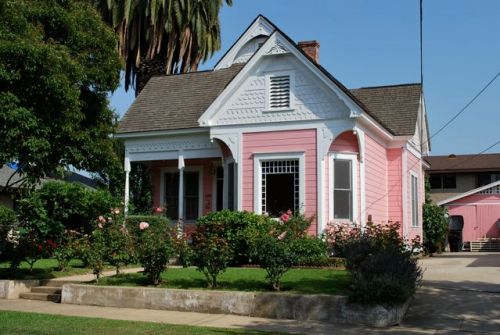 Alhambra is one of the most architecturally diverse cities in Los Angeles County. From elegant Victorian homes to classic Mid-Century Modern houses, from a hilltop castle built by a Frenchman to a rustic log cabin built by Boy Scouts, Alhambra boasts more than 25 different architectural genres and sub-genres in a mere eight square miles.
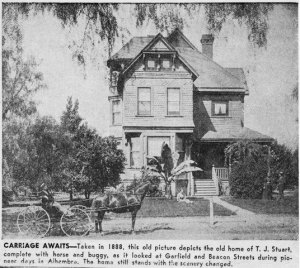 403 South Garfield – Easily Alhambra’s most recognizable Victorian home, this three-story Queen Anne Victorian home has stood at 403 South Garfield since the mid-1880s and was home to multiple families before it was even 50 years old. This house was home to the owner of a printing company, a teamster, a salesman and served as a boarding house called The Garfield during the 1920s. Listed in the 1984 Alhambra Historic Resources Survey, this home would qualify as local landmark status. A little known fact is that famed San Gabriel Mountains conservationist and hiker Will Thrall lived across the street from this home at 400 South Garfield during the early 20th century.
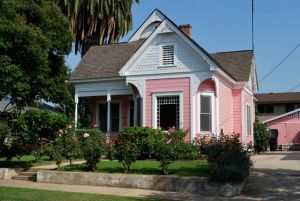 200, 204 and 208 Beacon Street – If you travel east on Beacon street from the Queen Anne Victorian home at 403 South Garfield, you’ll discover a trio of Victorian homes on the south side of the street. Brightly painted like Easter eggs, these Victorian homes are listed in Alhambra’s 1984 Historical Resources Survey as qualifying as a historic district. The two-story blue Queen Anne home located at 200 Beacon Street is especially significant to Alhambra’s history as it was the original home of Claude Adams – the son of George Adams, one of Alhambra’s earliest settlers. This home was originally located at the corner of Chapel Avenue and Main Street. It was moved to its current location on Beacon Street in the early 20th century.
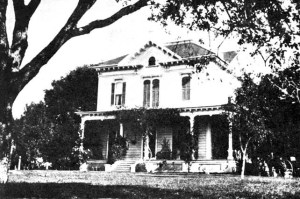 300 North Granada Avenue – This was the home of one of Alhambra’s founding fathers – James DeBarth Shorb – and his large family. James DeBarth Shorb’s wife was Maria, the eldest daughter of Alhambra’s founder, Don Benito Wilson. Rumor has it that this home may have been moved in the early 20th century from San Marino to the home’s current location on North Granada. Built in 1888, this house, which was built in the Italianate style, features characteristics that one would find in this Victorian-era architecture. The two-story house is sheathed in shiplap siding and features a truncated roof with bracketed cornices at the eaves line.
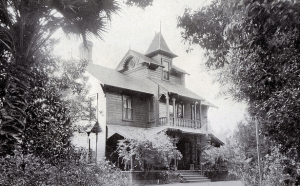 502 North Story Place – Francis and Charlotte Story built the home at 502 North Story Place in 1883. Its matching carriage house can be found a few doors down Story Place. Francis Q. Story was among Alhambra’s first leaders and played a huge part in the success of California’s fledgling citrus industry by creating the Sunkist brand of oranges that endures today. Mrs. Story was key in establishing Alhambra’s first library.
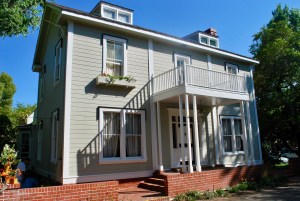 the corner of present day Almansor Street and Alhambra Road! Mr. Story’s citrus orchards stretched from the arroyo on the east to present day Main Street on the south.
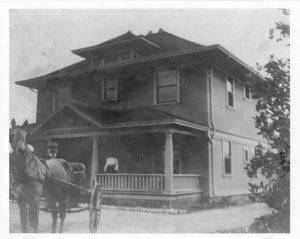 1306 West Pine Street – Located in the northwest corner of Alhambra, on the border of South Pasadena, this two-story Foursquare home was built in 1905 and was the original home of Adolph Graffen, an orchardist whose land holdings included the area from this home south to Alhambra Road and east to Atlantic Boulevard. A fun fact is that when Mr. Graffen subdivided his land in the early 20th century, present-day Marguerita Avenue was named after his daughter, Margie.
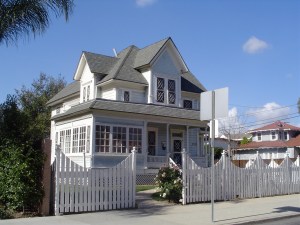 of present day Stoneman Avenue and Elgin Street. Elgin, Illinois was the birth place of Claude Adams and this may account for the naming of this small street in Alhambra. This was the home of Samuel and Emma Crow in the early 20th century. The Crows, in partnership with William Drake, owned Crow and Drake Grocers, which was located at 4 East Main Street, catty corner from the Alhambra Hotel. No doubt they did a booming business as “Dealers in Groceries, Hardware, Tinware, Provisions, Fruit, Flour and Feed” as their 1903 advertisement boasted.
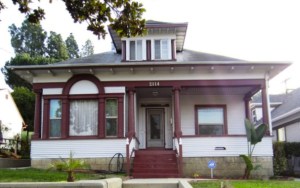 2114 and 2118 San Clemente Avenue – Tucked away on the corner of San Clemente Avenue and Date Avenue, just west of Alhambra’s Granada Park is a pair of transitional Victorian homes built in 1905 and 1910 respectively. Transitional Victorians were popular during this time and often included a mix of Victorian and Arts and Crafts characteristics. Built long before the Midwick Country Club was constructed, the owners of these homes were probably two of Alhambra’s earliest farmers or orchardists.
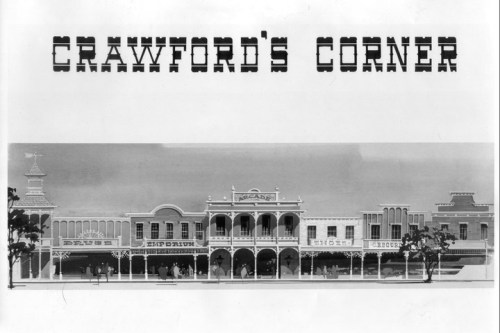 Crawford’s Grocery chain was a quintessential Southern California success story of the 20th Century; a family business that began very humbly, with the husband and wife team of Wayland and Leemoria Crawford selling watermelons off the back of a truck. They opened their first grocery store in Los Angeles in the 1920’s, followed by a vegetable stand in the City of Bell. The couple soon determined that the rapidly developing San Gabriel Valley and northern Orange County provided a more lucrative business climate, so they opened a chain of stores, which eventually included locations in Alhambra, Glendale, El Monte, Montebello, Monterey Park, Pasadena, Rosemead and Stanton. The Crawfords’ two sons, Ray and Billy, as well as their grandchildren were closely involved in the family business from the time they were youngsters.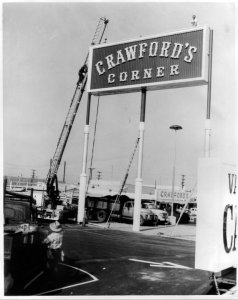
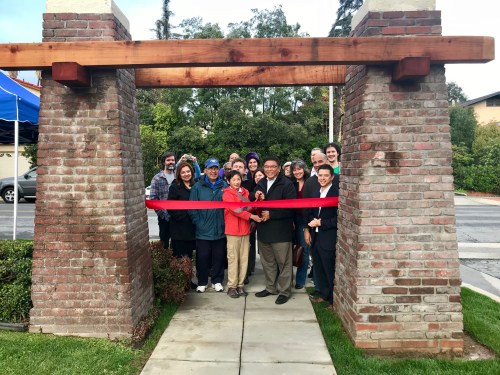 The call came in early one morning in 2016 – one of the Lindaraxa Park pillars had been hit and destroyed by a drunk driver. Lindaraxa Park residents were concerned and worried. What was going to happen to the other pillar? Would the City restore them? Would both pillars be torn down?
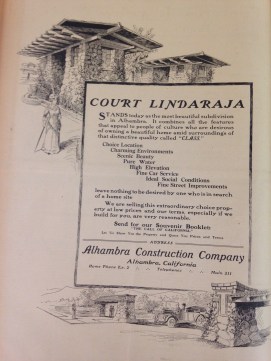 Lindaraxa Park residents and Alhambra Preservation Group representatives got to work – meeting with City of Alhambra representatives about restoring the pillars and combing through back issues of the Alhambra Advocate to try and find photos of the pillars. “We spent many hours at the library going through turn-of-the-20th-century issues of the old Alhambra Advocate newspaper,” said Joyce Amaro, Alhambra Preservation Group President. “While we never did find a photo of the current-day pillars, we found many advertisements – some of them full-page ads – for ‘Court Lindaraja.’ It was breathtaking to see what developers originally had in mind for this neighborhood.”
 As we kick off a new year,
  The Prose of Preservation