
A 1968 LA Times article on the destruction of the City-owned property.
By Oscar Amaro, APG Founder and 2019 President
A Carnegie library with gardens designed by Frank Lloyd Wright…The 1880’s Victorian home of Captain F. Edward Gray, a prominent Los Angeles horticulturalist…A 1920’s Tudor Revival clubhouse designed by Scott Quintin a well-known Alhambra architect…A 1910-era Arts & Crafts-styled building, which was the headquarters of “The Wednesday Afternoon Women’s Club”…The two-story Craftsman home owned by Norma Yocum, Alhambra’s first woman mayor…
Many cities would revel in the value afforded these architecturally and historically significant structures. Not in Alhambra. These are but a few of the noteworthy structures lost in the “Gateway to the San Gabriel Valley” as a result of an apathetic and negligent city hall.
Having grown up in the Alhambra/San Gabriel/Monterey Park area in the 1960s and 70s, even as a youth I was fascinated by this area’s treasure trove of historic buildings, homes, churches, schools—in addition to its rich history. Alhambrans may be unaware that US presidents found our city significant enough to make stops through here in the early part of the 20th century. Many of So Cal’s early leaders lived in Alhambra including a Captain F. Edward Gray, Los Angeles’ first commercial grower and main supplier of cut flowers to the region and president of the Southern California Horticultural Society as well as one of its first County Assessors. Captain Gray was also instrumental in securing funds to build one of Alhambra’s first schools and resided in an 1880s Victorian mansion. Captain Gray’s magnificent home was razed due to inaction and indifference on the city’s part despite strong calls from Alhambra’s residents to save it. In fact, the Alhambra Historical Society was formed in 1966 as a result of this debacle.
I moved away from this area in the early 1980s, living in both Riverside and Whittier, two cities that highly value their historic culture, architecture, and neighborhoods and take pride in these resources – as every city should. However, to be closer to work I moved back to Alhambra in the 1990s and was shocked to see so many of the historic structures that I remembered replaced by massive apartment and condo complexes. I was angered to see neighborhoods that were once quiet, picturesque and family-oriented gone. In 2000, my wife and I purchased a 1912 Craftsman home in Alhambra’s Ramona Park area. Shortly after moving in and restoring it to its period splendor, we witnessed the destruction of five 1920s bungalows just within a block of our house. That was the impetus for me to seek answers as to why this ongoing onslaught of our city’s historic character was continuing despite the Historical Society’s efforts.
When I formed Alhambra Preservation Group in 2003 with the late Katherine Hildreth, our mission was to begin lobbying our city leaders for historical and architectural protections. I naively thought that once our political leadership understood and were made aware of Alhambra’s robust architectural, historical and cultural resources, they would begin to adopt meaningful historic preservation measures. APG set out to educate our civic leaders and Alhambrans about the need to adopt legislation. We sponsored home tours, workshops and events, and a historic homes award program. We conducted a windshield survey of Alhambra’s historic resources and mapped out Alhambra’s more than 25 architectural genres and sub-genres. We met with city leaders again and again. More than 100 of our members staged a “Stand Up for Preservation” show of support in city council chambers in 2015. But in the 16 years since APG’s formation, we have seen little to no movement on the city’s part to enact historic preservation measures. Instead, our experience with city council members has ranged from empty promises and lip service to outright obstruction.
It became apparent that there is a very real and tangible resistance within Alhambra’s government to adopt any historic preservation measures and that no amount of negotiations with [past] city council members would have had any effect. This refusal of Alhambra’s leaders to listen to the concerns and demands of Alhambra’s residents is inexcusable.
But we are finally seeing changes.
With last year’s election, we now have several city council members who have voiced support in moving these efforts forward. Our board of directors has met with each of the newly elected council members to inform them about APG’s goals for 2019, to gauge their support and provide any guidance they may need.
What are these goals?
- Participate in the Alhambra General Plan process, ensuring that historic preservation goals, policies and implementation action items are included in the final documents.
- Update the partial 1984 historic resources survey and investigate what is required to conduct a citywide inventory of Alhambra’s historic resources.
- Host an annual members event.
- Attend city meetings including council, planning commission and the design review board as needed.
- Monitor the status of and advocate for threatened architectural resources throughout the city.
- Continue lobbying City Council to move forward with the development of a comprehensive historic preservation program.
APG remains committed to seeing substantive historic preservation measures enacted here in Alhambra. Nothing will deter us from our goal of preserving and protecting Alhambra’s historic homes, schools, businesses and churches. It is WAY past time.
Photo courtesy of LA Times archives.
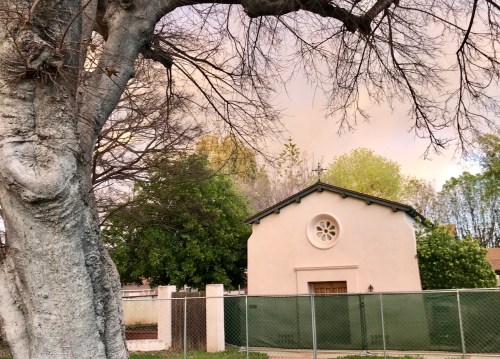 As 2019 begins,
  Alhambra is one of the most architecturally diverse cities in Los Angeles County. From elegant Victorian homes to classic Mid-Century Modern houses, from a hilltop castle built by a Frenchman to a rustic log cabin built by Boy Scouts, Alhambra boasts more than 25 different architectural genres and sub-genres in a mere eight square miles.
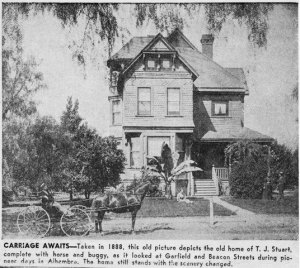 403 South Garfield – Easily Alhambra’s most recognizable Victorian home, this three-story Queen Anne Victorian home has stood at 403 South Garfield since the mid-1880s and was home to multiple families before it was even 50 years old. This house was home to the owner of a printing company, a teamster, a salesman and served as a boarding house called The Garfield during the 1920s. Listed in the 1984 Alhambra Historic Resources Survey, this home would qualify as local landmark status. A little known fact is that famed San Gabriel Mountains conservationist and hiker Will Thrall lived across the street from this home at 400 South Garfield during the early 20th century.
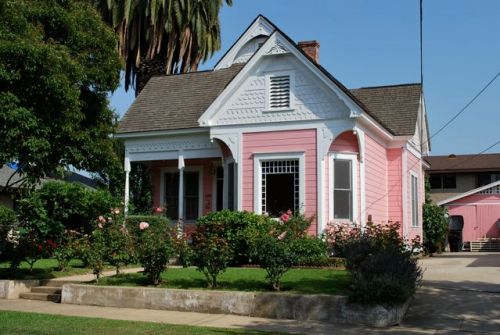
 200, 204 and 208 Beacon Street – If you travel east on Beacon street from the Queen Anne Victorian home at 403 South Garfield, you’ll discover a trio of Victorian homes on the south side of the street. Brightly painted like Easter eggs, these Victorian homes are listed in Alhambra’s 1984 Historical Resources Survey as qualifying as a historic district. The two-story blue Queen Anne home located at 200 Beacon Street is especially significant to Alhambra’s history as it was the original home of Claude Adams – the son of George Adams, one of Alhambra’s earliest settlers. This home was originally located at the corner of Chapel Avenue and Main Street. It was moved to its current location on Beacon Street in the early 20th century.
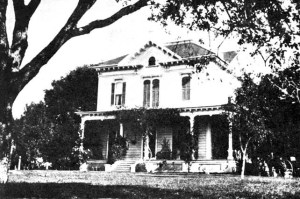 300 North Granada Avenue – This was the home of one of Alhambra’s founding fathers – James DeBarth Shorb – and his large family. James DeBarth Shorb’s wife was Maria, the eldest daughter of Alhambra’s founder, Don Benito Wilson. Rumor has it that this home may have been moved in the early 20th century from San Marino to the home’s current location on North Granada. Built in 1888, this house, which was built in the Italianate style, features characteristics that one would find in this Victorian-era architecture. The two-story house is sheathed in shiplap siding and features a truncated roof with bracketed cornices at the eaves line.
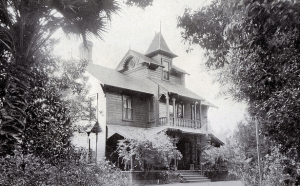 502 North Story Place – Francis and Charlotte Story built the home at 502 North Story Place in 1883. Its matching carriage house can be found a few doors down Story Place. Francis Q. Story was among Alhambra’s first leaders and played a huge part in the success of California’s fledgling citrus industry by creating the Sunkist brand of oranges that endures today. Mrs. Story was key in establishing Alhambra’s first library.
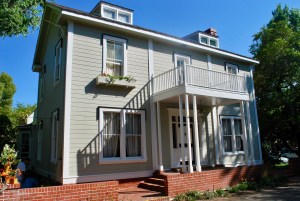 the corner of present day Almansor Street and Alhambra Road! Mr. Story’s citrus orchards stretched from the arroyo on the east to present day Main Street on the south.
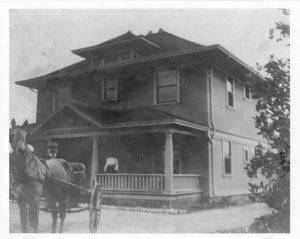 1306 West Pine Street – Located in the northwest corner of Alhambra, on the border of South Pasadena, this two-story Foursquare home was built in 1905 and was the original home of Adolph Graffen, an orchardist whose land holdings included the area from this home south to Alhambra Road and east to Atlantic Boulevard. A fun fact is that when Mr. Graffen subdivided his land in the early 20th century, present-day Marguerita Avenue was named after his daughter, Margie.
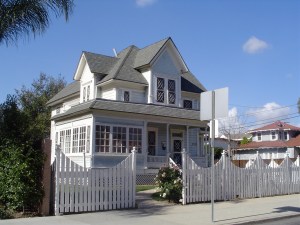 of present day Stoneman Avenue and Elgin Street. Elgin, Illinois was the birth place of Claude Adams and this may account for the naming of this small street in Alhambra. This was the home of Samuel and Emma Crow in the early 20th century. The Crows, in partnership with William Drake, owned Crow and Drake Grocers, which was located at 4 East Main Street, catty corner from the Alhambra Hotel. No doubt they did a booming business as “Dealers in Groceries, Hardware, Tinware, Provisions, Fruit, Flour and Feed” as their 1903 advertisement boasted.
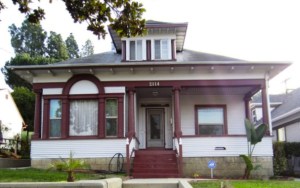 2114 and 2118 San Clemente Avenue – Tucked away on the corner of San Clemente Avenue and Date Avenue, just west of Alhambra’s Granada Park is a pair of transitional Victorian homes built in 1905 and 1910 respectively. Transitional Victorians were popular during this time and often included a mix of Victorian and Arts and Crafts characteristics. Built long before the Midwick Country Club was constructed, the owners of these homes were probably two of Alhambra’s earliest farmers or orchardists.
 The Prose of Preservation